

What Is A Flatbed Cutting Machine — And When Does Your Shop Actually Need One?
Oct 16, 2026
Leave a message

What Is a Flatbed Cutting Machine - and When Does Your Shop Actually Need One?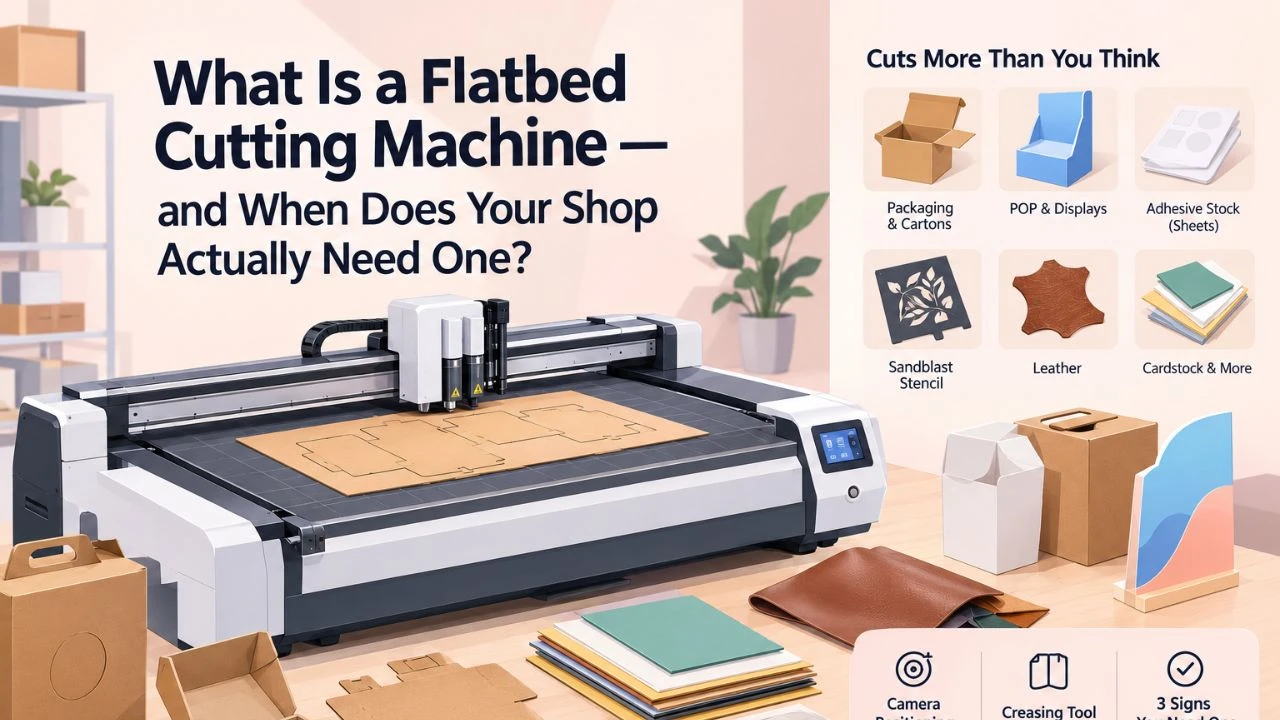
If your shop runs rolls, there's a category of work you've probably stopped noticing: sample boxes, POP displays, short-run cartons, stencils, rigid card jobs. You either turn it down, hand-cut it, or send it out - and none of those options shows up on your rate card as a loss.
A flatbed closes that gap. Unlike a roll plotter, it doesn't feed material through a gap - it lays the sheet on a table, holds it down with vacuum, and drives the head across it. That one mechanical difference is why it can cut materials a roll machine physically cannot. Here's the honest version of what it does and when it's worth the floor space.
Flatbed vs. Roll Plotter: The Difference That Matters
- Roll plotter (vinyl cutter) - flexible material feeds through, the blade follows the artwork. Built for vinyl, film, and other roll stock.
- Flatbed cutter - the sheet lies flat and is held by vacuum adsorption while a gantry moves the tool head. Built for sheets, boards, and thicker rigid stock.
Neither replaces the other. A flatbed won't run a 50-metre vinyl banner, and a roll plotter can't kiss-cut a card sheet or crease a folding carton.
What a Flatbed Actually Cuts
This is where the category earns its keep - the material list is broad and deliberately unglamorous:
- Packaging and cartons - gift boxes, corrugated and heavy card, folding cartons, short-run packaging.
- POP and retail display material - point-of-purchase board that has to be cut cleanly and folded accurately.
- Adhesive stock in sheet form - sticker sheets, labels, magnet stock.
- Sandblast stencil - the protective rubber layer used in etched and memorial work.
- Leather - for goods and detailing work where a clean edge matters.
- Craft and industrial stock - cardstock, kraft paper, PVC and PET sheets, heat transfer film.
Thickness is where you'll see the practical limit published plainly: on the F3550 flatbed the spec is stated as no more than 1mm / 400gsm. Always test your actual stock rather than assuming a category number covers your supplier's board.
The Line, Model by Model
Knowing the sizes is the fastest way to see whether a flatbed fits your work:
- PT4560 - 600 × 450mm cut area. Dual head, 2000g cutting force, ±0.05mm repeat and positioning accuracy, ±0.1mm cutting accuracy, 700mm/s cutting speed, 1500W vacuum pump adsorption, 180kg. 4.3-inch touchscreen, U disk / USB / WiFi (optional), CorelDRAW and Signmaster.
- PT6090 - the same platform at 600 × 900mm. 200kg, otherwise matching the PT4560 specification. This is the size that makes short-run carton and display work practical.
- F3550 - 420 × 480mm (A3+ class). 80kg, 1200mm/s maximum moving speed, HD camera automatic positioning, 2 heads, 2000g, ±0.1mm cutting accuracy and ±0.082mm repeat and positioning accuracy, under 100W, 1500W vacuum adsorption. Tool modes cover crease + cut and kiss cut + die cut. Runs CorelDRAW and an AI camera-cut plug-in on Windows.
- F3550 PRO - the same body with a rotary creasing upgrade. Adds an auto-rotating scoring wheel, which the spec sheet states applies up to ten times more pressure on the base material than a scoring stylus - the difference between a fold line and a clean fold.
- FCR6090 - roll-fed flatbed. Feeds from a roll up to 210mm in diameter, maximum sheet placement 630 × 1200mm, 600 × 900mm cutting area. 7-inch touchscreen, 2 tool clamps taking cutting blade, creasing blade, or pen (blades in 45°, 58°, and 60°). Cutting force is stated per head at 2000g left and 1000g right, with ±0.01mm repeat accuracy, ±0.01mm cutting accuracy, and 0.025mm mechanical resolution. Camera contour positioning reads L-corner and dot marks, auto feeding is supported, and jobs can be recognised by QR code. Connects over WiFi, USB, or network port.
Why the Camera and the Creasing Tool Are the Real Features
Two details separate a usable flatbed from a plotter on a table.
Camera positioning. On the PT series the CCD camera picks up printed marks across the sheet, and there's a four-point positioning calibration for it - that's what compensates for a printed sheet that has stretched or distorted through the printer. On the F3550 and FCR6090 the equivalent is HD camera automatic positioning reading L-corner and dot marks. Without it, print-and-cut on a flatbed is guesswork; with it, you can kiss-cut a sheet of printed labels, stickers, or packaging without hand-aligning anything.
Creasing. Fold lines are not cuts, and a blade alone gives you a weak, cracked fold on card. A creasing tool gives you a proper line where the material bends instead of tearing - and on the F3550 PRO the rotary wheel version is what makes heavier board fold without cracking. This is precisely the step most shops currently do by hand with a bone folder.
Three Signals That You Need One
- You're sending die-cut or box samples out. If you're paying a third party for short-run packaging or prototypes, you're already financing the machine - someone else is just keeping it.
- You hand-cut board. If someone in your shop spends real hours cutting card, stencil, or leather with a knife and a straight edge, you're paying skilled wages for a task a flatbed does faster and identically every time.
- Customers ask for short-run packaging or POP. The moment your order book contains requests you can't quote because you lack the capability, the capability has a customer already waiting.
What a Flatbed Doesn't Replace
Buy one expecting to retire your other machines and you'll be disappointed. A flatbed doesn't run roll vinyl at length, doesn't handle roll labels efficiently, and isn't built for phone films. Shops that get the most from a flatbed keep a roll plotter for flexible work and add the flatbed as the sheet and rigid complement - because the jobs genuinely don't overlap, which is exactly why the second machine has its own revenue attached to it.
The Takeaway
A flatbed cutting machine is the tool that turns rigid and sheet stock into a product you can sell: packaging, displays, stencils, creased card. Buy it for the jobs you currently outsource or hand-cut, size it to the sheets you actually handle, and make sure both camera positioning and creasing are in the spec - those two features are what decide whether it's a tool or a table with a head on it.
Not sure which flatbed size fits your work? Browse the Purcell flatbed cutting plotter range - including the PT4560 and PT6090 and the F3550 dual-blade A3 flatbed cutter - see how it fits sign and advertising and label and packaging work, or send us an inquiry and we'll match a table size to your job mix.