

How To Price Your Screen Protector Cutting Service: A Tiered Strategy For Mobile Shops
Jun 12, 2026
Leave a message

Riley
Industrial productivity specialist. If it doesn't scale, it's not a solution.
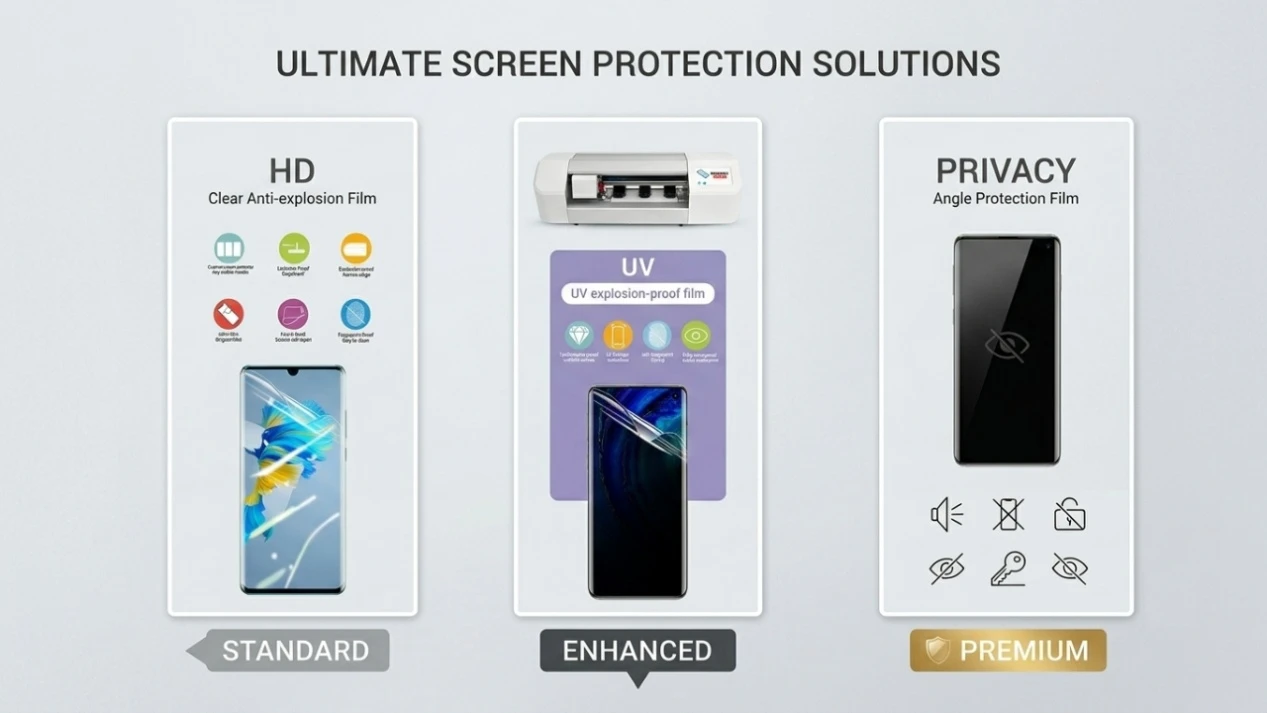 Most shops are leaving money on the table. Not because they lack customers - because they only have one price.Walk into most mobile shops today and the pricing structure looks something like this.Screen protector: one price. Maybe two if they stock both a cheap version and a slightly less cheap version.That is not a pricing strategy. That is a missed opportunity.The shops growing their film revenue fastest are not the ones cutting more volume. They are the ones who have built a tiered service structure - where different customers pay different amounts based on what they actually want and value.This article gives you the framework to build that structure in your own shop.
Why a Single Price Works Against You
When you charge one flat price for screen protector cutting, you are making a silent decision for every customer who walks in.You are telling the customer who just bought a flagship phone worth over a thousand dollars that their protection is worth the same as the customer who came in with a budget handset.You are also telling the customer who would happily pay more for better film, faster service, or added guarantees - that none of those options exist.Some customers will always buy on price. Accept that. But many customers - especially those with premium devices, busy schedules, or a history of cracked screens - are not shopping for the cheapest option. They are shopping for the option that feels worth it.If you only have one tier, you are invisible to them.The Three-Tier Framework
A practical tiered pricing structure for film cutting services does not need to be complicated. Three tiers cover the full range of customer intent and willingness to pay.Tier 1 - Standard ProtectionThis is your entry point. HD clear film, precision cut to the customer's exact device model, applied on the spot. Fast, clean, and reliable. This tier captures the price-sensitive customer and sets the baseline for your service quality. Browse Purcell's hydrogel HD film range for entry-tier material options.
The key point: even your entry tier should feel professional. A precisely cut film applied without bubbles or misalignment is already a better experience than anything a customer can buy in a blister pack. That gap in quality is your foundation.Tier 2 - Enhanced ProtectionThis tier adds a functional layer - whether that is a matte finish for reduced glare, a privacy coating to block side-angle visibility, a blue light filter for users who spend long hours on their device, or a higher hardness rating for better scratch resistance.The pricing logic here is not about the material cost difference, which is often small. It is about the specific benefit the customer is paying for. A professional who takes calls in open offices understands the value of privacy film. A student who reads on their phone every night understands the value of blue light filtering.Name the benefit clearly. Price it accordingly.Tier 3 - Premium ProtectionThis is your highest tier and it combines the strongest available film material with your best application process and a service guarantee. On the material side, this means your hardest, most impact-resistant option - whether that is a 7H RPET nano hard film, a UV-cured full-bond film, or an anti-shock hydrogel with reinforced edge adhesion.
On the service side, this is where you add what no pre-cut package can offer: a replacement guarantee within a defined window, a dust-free application environment, or a second application at no cost if the customer is not satisfied on the day.Customers buying Tier 3 are not comparing your price to the film in the phone case section at the supermarket. They are comparing it to the cost of a cracked screen repair. Frame it that way.How to Set the Price Gap Between Tiers
The specific numbers depend on your market, your location, and your existing customer base. But the ratio between tiers matters more than the absolute figures.A useful starting point: Tier 2 should be priced at roughly 1.5 to 2 times Tier 1. Tier 3 should be 2.5 to 3.5 times Tier 1.If your standard film service is priced at 10, your enhanced tier should sit around 15 to 20, and your premium tier around 25 to 35.These ratios hold because they reflect how customers weigh the decision. A customer who already decided to spend 10 will usually consider 15 to 18 as a reasonable upgrade if the benefit is explained clearly. The jump to premium requires a stronger reason - but the customers who need it will pay it without much resistance once the value is framed correctly.Avoid pricing your tiers too close together. If Tier 1 and Tier 2 are separated by less than 20 percent, most customers will not see a meaningful difference and will default to the cheaper option. The gap needs to feel like a real choice, not a rounding error.
The Most Common Pricing Mistake
The most common mistake is building the tiers around film material cost instead of customer value.Film material cost differences between tiers are often much smaller than the price differences customers are willing to accept. A matte finish or privacy coating may cost you only slightly more to cut. But to a customer who has been dealing with screen glare on their daily commute for months, or who works in finance and uses their phone in open offices, that coating solves a real problem.Price the solution, not the material.The second mistake is not training staff on how to present the tiers. A pricing menu on the wall does nothing if the person behind the counter defaults to asking which one do you want without explaining what each tier actually means.Your staff should be able to describe each tier in one sentence - what it includes and who it is for. Not a technical specification. A reason.Adding a Back Film Tier
If you are already offering back film cutting - or considering it - apply the same tier logic separately.Back film sits in a different category from screen protection in the customer's mind. It is not primarily about safety. It is about personalization and appearance. That means the pricing conversation is different and the upgrade path is different.A standard back film tier covers a clean matte or clear finish. A premium back film tier covers patterned, textured, or custom-color options. The upgrade sell here is not about protection - it is about identity.Keep the two service categories visually separated in your shop and on your menu. Customers who come in for screen protection and leave with a back film are not upsold - they discovered something they did not know they wanted. That only happens if the option is clearly visible and clearly explained as a separate choice.The Practical Summary
Build three tiers. Name each one by what it does, not by what it costs.Standard Protection - precision cut, clear film, applied on the spot.Enhanced Protection - functional coating matched to the customer's daily use pattern.Premium Protection - strongest available material plus a service guarantee.Price the tiers with enough separation that each one feels like a distinct choice. Train your staff to present the tiers as options, not as a menu to scroll past.The customer who pays for Tier 3 is not a rare event. They are in your shop right now, standing at your counter with a flagship device, waiting to be given a reason to spend more than the minimum.The shops that build a clear tier structure capture that customer every time. The shops that don't - hand them a cheap film and wonder why margins never improve.Further Reading
Once your tiers are set, your next challenge is training staff to convert. Read our guide on sales scripts:Stop 'Just Cutting' and Start Selling: 3 High-Conversion Scripts to Triple Your Film Margin
If profit leakage in your shop goes beyond pricing, see:
Why Your Mobile Shop Is Leaking Profit (And How the Purcell H310PRO Fixes It)Purcell provides mobile film cutting solutions across
hydrogel, RPET hard film, UV-cured, and specialty coating materials
- giving shops the product range to build a genuine tiered service menu. Contact the Purcell team to discuss which film combinations fit your service structure.