

Cast Vs. Calendered Vinyl — Which Roll Should You Actually Stock?
Sep 24, 2026
Leave a message

Cast vs. Calendered Vinyl - Which Roll Should You Actually Stock?
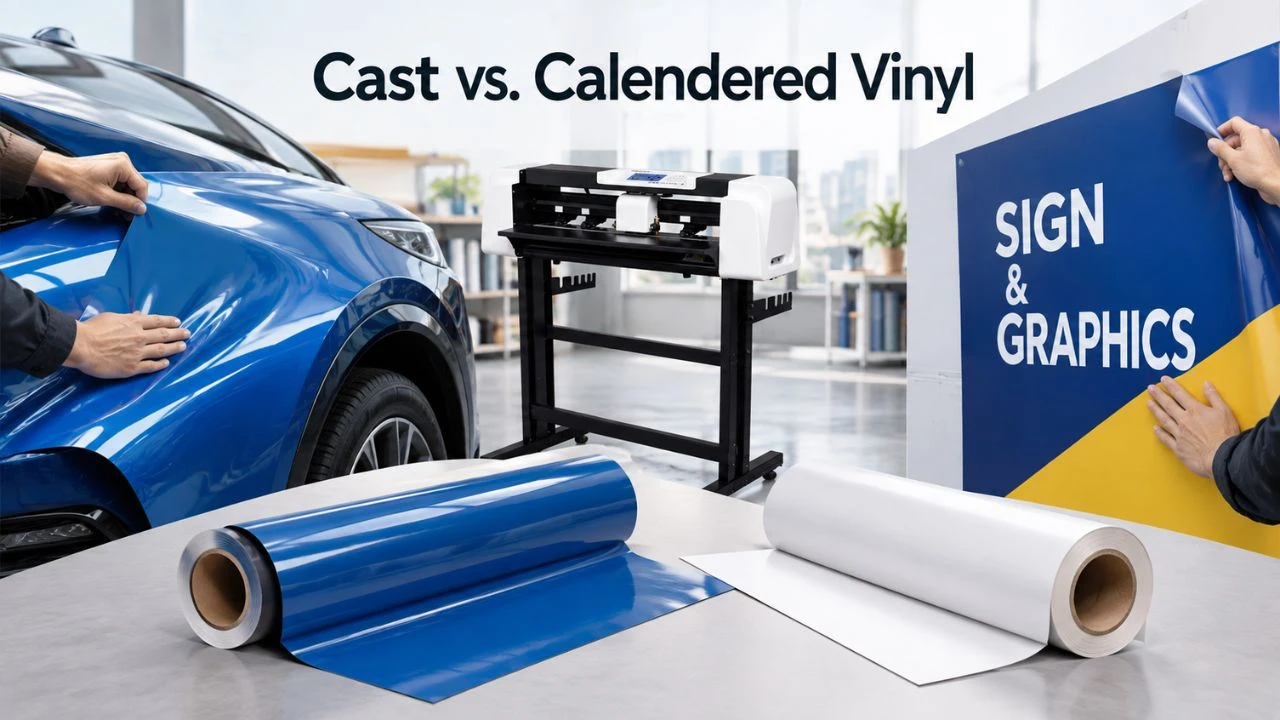
Every supplier catalog lists both, the price difference is roughly double, and nothing on the label tells you which one the job in front of you actually needs. So most shops buy the cheaper roll by default and find out the difference six months later, on a customer's car.
Here is the practical version - what the two films really are, where each one earns its price, and the minimum shelf you need to stop guessing. If you already run a Purcell SD series plotter, both films cut on the same machine. The difference is what happens after it's applied.
The Difference Is How the Film Is Made
Both are PVC. The manufacturing route is what separates them:
- Calendered vinyl is squeezed between heated rollers and stretched to its final thickness. That stretching leaves stress in the film, and the film spends the rest of its life trying to relax back - which is why it shrinks.
- Cast vinyl is spread as liquid PVC onto a casting sheet, cured, then peeled off. Nothing is stretched, so nothing pulls back. It comes out thinner and dimensionally stable.
The practical consequence is conformity. Cast film drapes into curves, rivets, and recesses and stays there. Calendered film fights you on a compound curve and then lifts a little at the edges over time as it relaxes.
Where Each Roll Earns Its Price
Neither film is "better." They're priced for different jobs:
- Cast - anything that goes on a vehicle, decals on curved surfaces, long-term outdoor signage, and any job where shrinking shows up as a failure instead of a nuisance.
- Calendered - flat panel signs, indoor graphics, wall decals, short-term promotions, banners, and label stock. Flat surfaces and short life cycles are exactly what it's built for.
Notice that the deciding factor isn't the customer's budget - it's the shape of the surface and how long the graphic has to survive on it.
Why the Cheaper Roll Can Cost More
The savings from calendered film happen on the day you buy it. The cost happens months later, on site:
- Edge lift and dirt lines. As the film relaxes, the edges creep, collect dirt, and read as "cheap work" to the customer.
- The repeat visit. You saved a fraction of the material cost on the original job and now you're paying for the full labor of a second install.
- Fleet inconsistency. On a multi-vehicle order, one panel shrinking differently from the next is visible immediately.
Use calendered film on a flat panel and it will serve you well for years. Use it on a compound curve and you've written yourself a comeback.
The Minimum Shelf a Sign Shop Needs
You don't need a warehouse. You need enough coverage to stop substituting the wrong film:
- One cast roll for everything that touches a vehicle or a heavy curve.
- One calendered roll for flat, indoor, and short-term work where the economics actually favour it.
- Reflective film if you take safety or traffic-adjacent work - it's a distinct product with its own handling, not a colour variant.
- Heat-transfer film if you do apparel: it's cut mirrored, weeded, and pressed, which is a different workflow from adhesive vinyl.
- Application tape in the widths you actually use, in both paper and clear.
What the Plotter Has to Handle
The two films differ in thickness, and thickness is what your blade meets on the first cut. The SD series covers this with 2000g of blade force and ±0.1mm repeat accuracy at up to 600mm/s, and the SD spec sheet describes its cuttable material range as extensive rather than listing a short list - which is the honest way to put it, because formula differences between brands matter more than the category name.
Two habits keep this reliable across suppliers:
- Test-cut every new roll before it goes into a paid job. Force and speed settings that worked on your last supplier's film are not automatically right for the next one.
- Match the blade to the material. A steeper blade angle handles thicker and denser film better; a shallower one gives you finer detail on thin stock. Keep both on hand and stop forcing one blade to do everything.
Storage Matters More Than Most Shops Admit
Vinyl is only as good as its adhesive, and adhesive has a shelf life. Store rolls upright or in their original box rather than stacked flat under a window, keep them out of direct heat, and use the oldest stock first. A roll that has baked in a hot workshop over a summer will not behave like a fresh one, no matter what the grade says.
The Takeaway
Buy cast for curves, vehicles, and long-term outdoor work. Buy calendered for flat, indoor, and short-life work. Test-cut every new roll, keep two blade angles, and store stock properly. That's the whole discipline - and it's the difference between a film decision you stop thinking about and a re-install you didn't quote.
Choosing a plotter to run both properly? Browse the Purcell vinyl cutting plotter range, see the workflows it supports in sign and advertising, or send us an inquiry and we'll help you match the machine to the films you actually stock.