

SD720 Vs SD1350 Vs SD1600: Which Cutting Width Do You Actually Need?
Nov 10, 2026
Leave a message

SD720 vs SD1350 vs SD1600: Which Cutting Width Do You Actually Need?
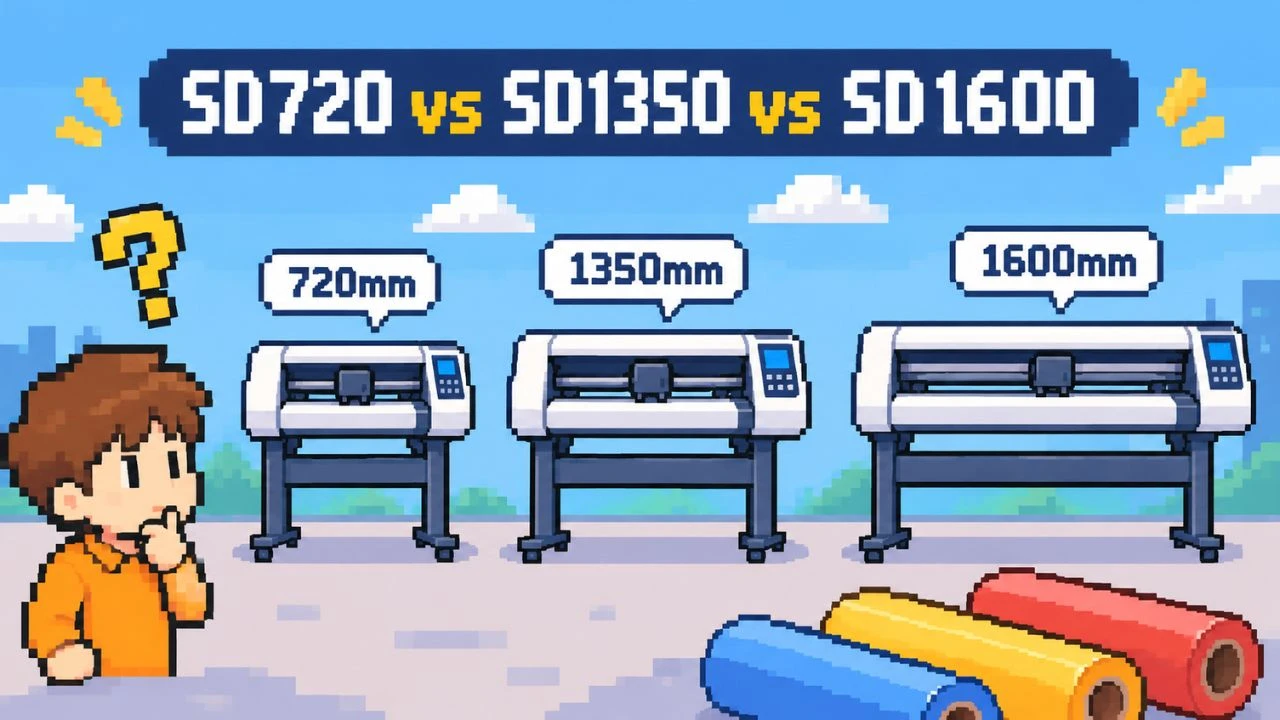
The gap between the model number, the cutting width, and the contour-cut width is where bad purchases happen: a shop orders the 1350 because it looks like it covers a 54-inch roll, then finds the roll will not feed. This guide splits those three numbers apart, then works backwards from the material you actually buy.
Three numbers per machine, not one
Every SD model carries three different widths, and they are not interchangeable:
- Maximum feeding width - the widest media the machine will accept, including the margins the pinch rollers grip. This is the number in the model name.
- Maximum cutting width - how far the blade actually travels across the media.
- Maximum contour-cut width - the usable width when the camera has to find and track printed registration marks.
From the published SD series specification:
- SD720 - feeds 720mm, cuts 610mm, contour-cuts 500mm. Net weight 18kg. Floor stand optional.
- SD1350 - feeds 1350mm, cuts 1240mm, contour-cuts 1150mm. Net weight 39kg. Floor stand included.
- SD1600 - feeds 1650mm, cuts 1540mm, contour-cuts 1500mm. Net weight 50kg. Floor stand included.
Notice the pattern: each step down the list costs you roughly 110mm before you cut anything, and another 40 to 110mm if the job needs registration marks. The model number is the most generous of the three figures, and it is the one buyers anchor on.
Start from the roll, not the machine
The cleanest way to choose is to work backwards from the media you already buy. Vinyl is normally sold in nominal imperial widths, which convert as follows:
- 24 inch - nominally 610mm. Matches the SD720 cutting width exactly.
- 48 inch - nominally 1220mm. Fits the SD1350, which cuts 1240mm.
- 54 inch - nominally 1370mm. Does not fit the SD1350: its feeding width is 1350mm, which is 20mm short of the roll. This is the single most expensive misread in the range.
- 60 inch - nominally 1520mm. Fits the SD1600, which cuts 1540mm and feeds 1650mm.
Two practical notes. First, these are nominal figures - suppliers vary by a few millimetres, so measure a roll from your own rack before you commit, especially if you sit close to a limit. Second, if you buy by the metre from a distributor who stocks 1370mm material, the SD1350 is out of the question no matter how good the price looks; the SD1600 is the only model in the series that will take that roll.
What each job type actually demands
Width requirements differ far more by application than by material:
- Sign and panel work - standard substrate panels arrive around 1220mm, so the SD1350 covers most flat sign cutting. Narrow letter sets and small logos come off 610mm offcuts, which the SD720 handles. See the work this covers on our sign and advertising page.
- Vehicle graphics - printed wrap panels are commonly produced at 1520mm, which puts them on the SD1600. Keep in mind that the contour-cut width is 1500mm, so registration marks have to sit inside that band; do not plan a mark in the outer 20mm of a full-width panel. Application detail is on our vehicle decoration page.
- Heat transfer vinyl - garment work is limited by the platen and the print, not by roll width. A 610mm machine covers most jersey and tee graphics, and the SD720 is usually enough. See heat transfer and home decor.
- Stickers and labels - narrow rolls and sheet work rarely need more than the SD720, but if you nest many small jobs across a wide sheet to save material, width pays for itself in yield.
The real cost of buying too narrow
A machine that is one size too small does not fail loudly. It slows everything down:
- Panels get spliced, and a splice is a visible seam plus a callback risk.
- Wide jobs are split into two runs with a manual alignment step between them.
- Long runs stop being economical, because nesting is limited to a narrower bed.
- You start declining the work that pays best - full-colour vehicle panels and wide banners.
The real cost of buying too wide
The opposite mistake is quieter but also real:
- Floor space. The SD1600 needs room for a 1650mm media path plus clearance at both ends. In a small shop that is a layout problem, not a specification problem.
- Weight and handling. 50kg plus a floor stand is not a one-person lift, and it will not sit on a bench.
- Narrow rolls on a wide machine. Loading 610mm stock on a 1650mm machine means repositioning rollers and watching skew more carefully; it works, but it is not where the machine is happiest.
- Idle capacity. Paying for width you use twice a year is capital sitting on the floor.
What is identical across all three
This is the part that should make the decision easier. The cutting engine does not change with width:
- Maximum cutting force of 2000g, across the full range.
- Maximum cutting speed of 600mm/s, maximum moving speed of 700mm/s.
- Cutting accuracy of ±0.1mm, repeat and positioning accuracy of ±0.082mm.
- Two heads, CCD camera positioning, 128MB processor memory, stepper motor.
- USB and U-disk as standard, WiFi optional.
So you are not trading performance for size. You are choosing one number: how wide a roll you want to feed. The full model breakdown sits on the SD series vinyl cutting plotter page, and the wider range is on our vinyl cutting plotter category page.
Three questions to answer before you order
- What is the widest single piece you must cut in one pass? Base this on jobs you have quoted in the last twelve months, not on work you hope to win.
- What roll widths do your suppliers actually stock? Take a tape measure to your rack. If 1370mm is a standard line for you, the decision is already made.
- Do you cut to printed marks? If yes, plan against the contour-cut width, not the cutting width. That is where the SD1350 loses 90mm and the SD1600 loses 40mm.
Bottom line
Buy the width your rolls and your largest single panel demand, and accept that the model number overstates what you can cut. SD720 for 610mm stock and garment work, SD1350 for 1220mm sign panels, SD1600 for 1520mm wrap and banner production - and if 1370mm media is on your shelf, skip straight to the SD1600. The cutting performance is the same on all three, so this is a material-handling decision, not a specification contest.
Not sure which width matches your order book? Look over the vinyl cutting plotter range, check the SD720 / SD1350 / SD1600 specifications, and tell us the widest roll and the largest panel you handle. We will confirm the model and the tooling with you through our inquiry page.